Comparing the Serengeti and the Maasai Mara is almost inevitable when planning a safari. Although they share wildlife and the migration, each park offers nuances that can influence the traveler’s experience. Choosing between one or the other isn’t always easy.
1. The context of visiting the Serengeti and the Maasai Mara
The first time we went on a safari in the Serengeti was during our honeymoon in 2021. At that time, Covid-19 was still taking its toll and Tanzania was one of the few countries open to tourism.
In contrast, the first time in the Maasai Mara was while working with our travel agency and opening routes in Kenya.
Context is important, as in 2021 we were on one of the most beautiful trips we’ve ever taken, and it was after that trip that we decided to start triptohelp.org. In Kenya, however, we always went as part of our work at Triptohelp.org
2. General information about each park
Serengeti (Tanzania)
- Approximate size: 14,763 km².
- UNESCO World Heritage Site.
- Part of the Great Migration and the same ecosystem as the Maasai Mara.
- More than 557,000 visitors in 2023.
Maasai Mara (Kenya)
The Maasai Mara is divided between the Mara National Reserve and several conservancies. In this article, we will talk about the National Reserve, known as the Maasai Mara. But in reality, the Maasai Mara encompasses much more than just the Reserve. You can find more information here.
- Size: 1,510 km²
- Shared ecosystem with the Serengeti.
- More than 300,000 visitors per year.
- Greater accessibility from Nairobi.
99% of the safaris sold visit the National Reserve, but this doesn’t mean it’s the best area for a safari.
3. Differences in landscape and atmosphere
The Serengeti and the Maasai Mara belong to the same ecosystem; only a man-made “artificial” border has divided the same park in two. Tanzania named it the Serengeti (“endless land” in the Maa language) and the Kenyan part was named the Maasai Mara (land of the Maasai).
Fun fact: Did you know that the Maasai are the only ones who can cross the border between the two parks without needing visas or passports?


The feeling I had on my first safari in the Serengeti made me perfectly understand the meaning of Serengeti, “endless land.” The vastness you see when you arrive at the park is hard to match anywhere else in the world.
The Maasai Mara, on the other hand, is a bit more fragmented and I didn’t get that feeling of an endless plain, as it has more varied terrain. Also, as mentioned before, the Maasai Mara National Reserve is smaller than the Serengeti, so the feeling of cars crowding around animals tends to be greater.
In the Serengeti, you can “get lost” more easily than in the Maasai Mara. And if the guide DOESN’T use walkie-talkies, even better, as they will be looking for the animals themselves.
4. What animals can be seen in the Serengeti and the Maasai Mara
Both parks form a single migratory ecosystem with more than 1.5 million wildebeest and thousands of zebras. In the Serengeti, the migrations are longer and they spend more time in the Tanzanian part than in the Kenyan part. It’s common to see large herds spread across vast areas. Like in the following photo we took.

In both parks I’ve seen everything, from large predators to elephant families. It’s very easy to see lions, giraffes, elephants, and buffalo in both parks. Cheetahs are also usually seen relatively easily. The leopard is one of the hardest predators to spot in both places.


But it’s not just wildebeest and zebras that move; elephants also migrate, and in fact, we’ve occasionally seen some of the largest elephants in the ecosystem outside the National Reserve. For example, we saw this elephant—one of the largest in the Mara-Serengeti ecosystem—in a Mara conservancy, completely alone with no one around us. He was going to find his group (family) and we ran right into him…

If you want to see the Great Migration in summer (July-September), it is located in the Maasai Mara part of Kenya. You can see it in the Northern Serengeti, but access is much more difficult (and expensive) than in Kenya.
On the other hand, if you travel at another time of year, you can time it for when it’s in the Serengeti; however, since it’s much larger, it’s sometimes hard to find. Keep in mind that the Great Migration follows the rains and that climate change causes the wildebeest to take different paths.
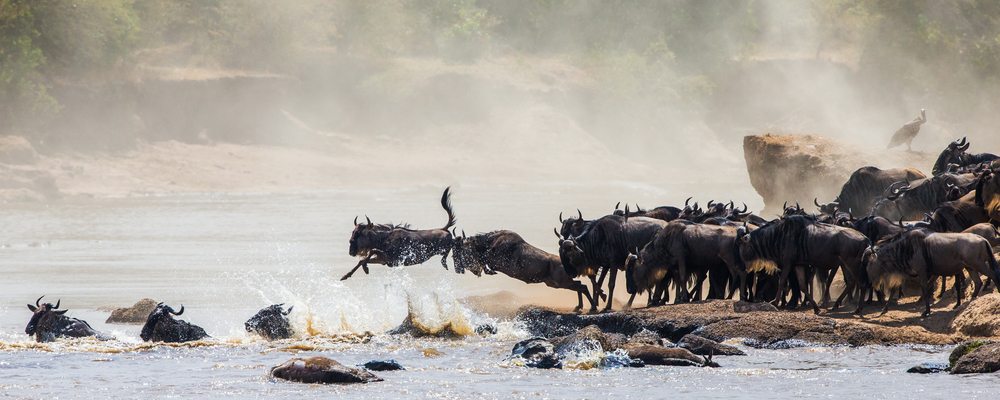
The famous wildebeest crossing of the Mara and Talek rivers is seen more easily on the Kenyan side but can also be seen in the Northern Serengeti.
5. Tourism levels and overcrowding
The level of tourism and overcrowding in the Maasai Mara and in some parts of the Serengeti are a real problem that we all must fight against so these ecosystems don’t disappear. Humans are and will be the main culprits in the decline of predators and other animals.
Tourism can allow an area to be better conserved thanks to the resources it generates, but it can also create other problems like overcrowding (disturbing the animals) or even a more recent issue happening in the Maasai Mara with an accommodation that has been built in the middle of a wildlife migratory corridor. If we humans obstruct a migratory corridor that has existed for centuries, we are putting the entire ecosystem in crisis. That’s why before staying at a hotel inside or outside the National Reserve, check carefully if the hotel is responsible, if the workers are local, or if it dedicates part of its income to helping the community with education or health, etc.
That said, the Maasai Mara usually gets crowded in the summer for the river crossing. If you want to see the Great Migration, it’s “just how it is.” If, on the other hand, you want a quieter safari, I advise you to visit other areas of the Maasai Mara where, outside the Reserve, you can enjoy a much more peaceful safari.
The Serengeti, being much more extensive, makes it easier to “get lost.” But if your intention is to see the river crossing from the Tanzanian side, you will also find many cars, perhaps fewer than in the Maasai Mara due to its more difficult access.
6. Accessibility and logistics
By car, the Maasai Mara is more accessible than the Serengeti.
It takes fewer hours by car to reach the Maasai Mara than to reach the Serengeti. Additionally, to get to the Serengeti, you have to cross the Ngorongoro Conservation Area, which has an extra cost.
Both parks are accessible by plane. In this case, the time difference is more similar.
If you want to see the Great Migration from Tanzania, you will need several days to reach the Northern Serengeti (a minimum of 2-3 nights inside the park plus some nights along the way is recommended). That is, about 6 days of safari.
In contrast, if you want to see the Great Migration in the Maasai Mara, since it’s much closer, 3 days is enough.
This makes the price much higher on the Tanzanian side than on the Kenyan side due to operational-logistical issues. Furthermore, hotels in the Northern Serengeti are especially expensive. In the Maasai Mara, however, if you stay outside the Reserve, you can find affordable accommodations (120 euros per night full board).
Tip: For distances and routes in Africa, don’t trust Google Maps.
7. Activities and Accommodations in the Serengeti and the Maasai Mara National Reserve
Being the same ecosystem, the type of safari is similar, even though one is much larger: the Serengeti.
When we go to the Serengeti, we always sleep inside the Park, either in a hotel or in a camping area.
In the Mara National Reserve, however, you can sleep either inside or outside. Being a smaller park, the accommodations inside are more exclusive and expensive. Outside the Maasai Mara, you can find very affordable accommodations.
In both parks, you can go camping inside the Park in specially designated areas.
During the Great Migration, we camp in a private area between the Talek and Mara rivers which allows us to be very close to both crossings.


Balloon safaris are ideal activities for couples celebrating their honeymoon and can be done in both parks.
9. Conclusions Maasai Mara VS Serengeti.
My recommendation for a safari in Kenya is to combine the National Reserve with a Maasai Mara conservancy. Combining two areas is much more interesting than focusing only on the National Reserve. Why? Usually, the conservancies are areas with far fewer cars than the reserve. You’ll be able to enjoy a much more peaceful safari and do other activities like walking safaris, meals in the middle of the savannah, etc. In other words, in the Maasai Mara conservancies, you can enjoy a safari with fewer cars while doing other activities that aren’t allowed in the reserve (due to restrictions).
On the other hand, when you go on a safari in the Serengeti, because it’s so large, you should stay at least 2 nights inside the park, whether in a glamping-style hotel or camping. Being such a large park, you might have a greater sense of “freedom” than in the Maasai Mara Reserve. That’s why I recommend that in Kenya you always combine the Reserve with a conservancy.
If you have a small budget, I recommend doing the safari in the Maasai Mara and traveling during the first months of the year (from January to June) when park entry fees are 100 USD per person. From July 1st, entry fees are 200 USD per person and the price of the safari goes up significantly.
Which park is better?
In general, I like the Serengeti more than the Mara National Reserve.Mainly because of its size and for being far from villages and cities. But if we combine the Mara Reserve with a conservancy, then I don’t have a clear favorite. In the conservancy, the safari is experienced with much more tranquility and with activities that we can’t do in a national park. When we mix the Reserve with a conservancy, both options are equal and I’m unable to decide which is better, the Serengeti or the Maasai Mara. Only when we understand the Maasai Mara as an ecosystem much larger than the Mara National Reserve is when, from my point of view, the Maasai Mara and the Serengeti become equal.
10. How to book your safari in the Serengeti or the Maasai Mara
If you’ve made it this far, it means you’re considering a safari in Tanzania or Kenya. It’s normal to still have doubts after reading this article and want more information. Here is more.
If you still have questions, you can send us a WhatsApp or email and we’ll organize a call with no obligation.
Trip to Help is a respectful and regenerative travel agency with the goal that tourism doesn’t stay in just a few hands but benefits the entire local community. In 2024, we won an international responsible tourism award in Africa, being the only European or American company honored.
Want to go on a safari? Contact us with no obligation.

More articles about Travel
- Seeing Gorillas in Uganda: Our Bwindi Experience
 Seeing gorillas in Uganda is one of those experiences that’s hard to imagine until you’re right there with them. Venturing into the tropical forest, walking for hours in search of a mountain gorilla family, and coming face-to-face with these impressive primates is an unforgettable experience. In our case,…
- Safari in Queen Elizabeth Park, Uganda
 The safari we went on in Queen Elizabeth Park in Uganda was probably the most complete and beautiful experience of our trip to Uganda. We stayed two nights in the park, and during those two days, we did 3 activities: The combination of these 3 activities, along with…
- Samburu Safari: a guide to discovering one of Kenya’s best reserves
 Why go on a safari in Samburu? Samburu National Reserve is ideal if you want to go on safari in a reserve with very little tourism. Its location, far from the Masai Mara, means many people choose not to go. That keeps visitor numbers low, and it’s also…
- Safari in Murchison Falls: our experience in Uganda’s national parkMurchison Falls is much more than a waterfall. This national park, in northern Uganda, combines sweeping savannah landscapes, wildlife, the Nile River, and falls that truly impress when you’re standing right in front of them. On top of that, experiencing a safari in Murchison Falls is a unique…
- Serengeti or Maasai Mara: which is the best safari?Comparing the Serengeti and the Maasai Mara is almost inevitable when planning a safari. Although they share wildlife and the migration, each park offers nuances that can influence the traveler’s experience. Choosing between one or the other isn’t always easy. 1. The context of visiting the Serengeti and…
- Arusha National Park: complete safari guideLocated in northeastern Tanzania, between Kilimanjaro and Mount Meru, Arusha National Park is one of the least known parks in the country. Despite its relatively small size (137 km²), it offers an impressive variety of landscapes and wildlife, making it an ideal choice for a first safari with…
- Mandatory insurance for travel to Tanzania and ZanzibarIf you are traveling to Tanzania and/or Zanzibar or plan to go soon, this interests you. As of October 1, 2026, foreign tourists entering mainland Tanzania must have mandatory travel insurance managed by the National Insurance Corporation (NIC). This new obligation is in addition to the mandatory insurance…
- Seeing the Great Migration in Kenya: An Unforgettable Natural Spectacle
 Watching the great migration in Kenya is one of the most impressive natural phenomena in the world. This annual event attracts thousands of tourists and nature lovers eager to witness the majesty of wildlife at its best. At Trip to Help, we are excited to offer you the…
- TRIP TO HELP, WINNER OF THE AFRICA WTM RESPONSIBLE TOURISM AWARDS
 Trip to Help, the online agency for responsible and regenerative travel, born in Barcelona, receives in its second year of life the the most outstanding recognition, the GOLD award, from the prestigious World Responsible Tourism Awards, held within the framework of the annual international tourism fair World Travel…
- Our visit to Lake Natron in TanzaniaLake Natron (Lake Natron), in northern Tanzania, is one of the most mysterious places in Tanzania. Its reddish color, its volcanic landscapes and its flamingos, make it an ideal destination to get away from the classic 5-day safari in Tanzania. Located in one of the most remote areas…
- How much does a Kenya Safari Cost?Going on safari in Kenya is a unique trip in the world, and although nowadays there are cheaper alternatives, it is still expensive and not suitable for all budgets. How much does it cost to go on safari in Kenya? Why are some cheaper than others? Are all…
- Original Maasai Lodge: An example of sustainable lodgingThe Original Maasai Lodge is a very special lodge, ideal if you are looking for an exclusive and different place, but that at the same time dedicates all its profits to social projects. Located in front of Kilimanjaro, and in the middle of the Maasai area, the Original…
- How to make a sustainable trip to Kenya: Tips & TricksADCAM’s accommodation in the Maasai Mara, a sustainable lodge for a sustainable trip in Kenya.
- Sustainable Safari in TanzaniaWhen we travel to Tanzania for a safari, we have a moral and ethical responsibility to try to make it as sustainable as possible. In a safari, as in most trips, we can decide what kind of impact we will have on the territory. And if we are…
- Sustainable Travel in TanzaniaTanzania is a destination that receives many tourists every year, thanks to breathtaking natural landscapes, abundant wildlife, safaris in world-renowned national parks, and idyllic beaches. In 2019, Tanzania welcomed 1.5 million international tourists and aims to increase this number to 5 million by 2025. However, the growth of…
- Money in Kenya: tips and tricksToday, I’m going to share some money tips and tricks for traveling to Kenya. How much cash should I bring? What currencies are accepted in Kenya? Are ATMs readily available? Can you use a credit card in Kenya? These are some of the common questions we receive when…